Plan a charging record around the documented light
Separate a bicycle light's charge-time specification from runtime claims and your own observed charging record.
Updated:
Keep charging and running time in separate columns
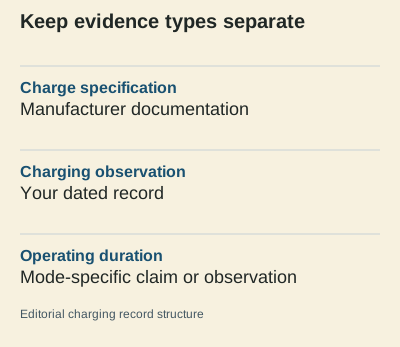
A light's charging specification and its operating duration answer different questions. Record both with the exact model and relevant instructions before planning how the equipment will be used. Do not read a long eco-mode headline as a statement about how quickly the battery becomes ready. Equally, a stated charge duration does not tell you how long every mode will operate. Keeping the two fields separate makes it easier to ask the manufacturer a useful question when the listing is abbreviated or a bundle includes different equipment.
Knog Blinder900 specifications ? Knog Blinder900 current mode table ?
Record the manufacturer's stated values
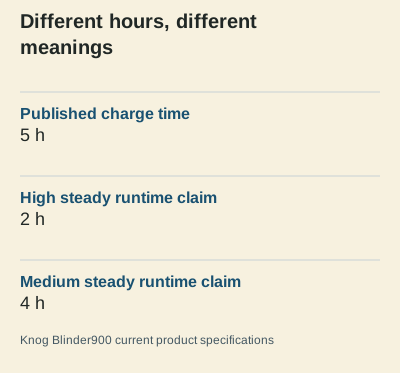
Knog lists a 5 hour charge time for the Blinder900. Its separate mode table gives 2 hours for high steady and 4 hours for medium steady, with longer figures for other modes. These are different specifications, not a ratio that can be used to calculate partial charging. We have not measured the charging curve or runtime. Do not assume that half the stated charging time produces half the advertised operating duration. Follow the actual charging instructions, including the specified equipment and conditions, rather than constructing an unverified shortcut from the headline numbers.
Check the connection and included equipment
The product page identifies USB-C charging and says a cable is not supplied. Record that exclusion when comparing packages, and confirm any power-supply requirements in the current instructions. A connector shape alone does not establish every electrical requirement or guarantee that a particular cable and supply are suitable. If the seller's bundle includes additional charging equipment, ask what it is and whether it matches the manufacturer's requirements. Keep the answer with the light model so that accessories from another device are not silently assumed to be appropriate later.
Write observations without turning them into promises
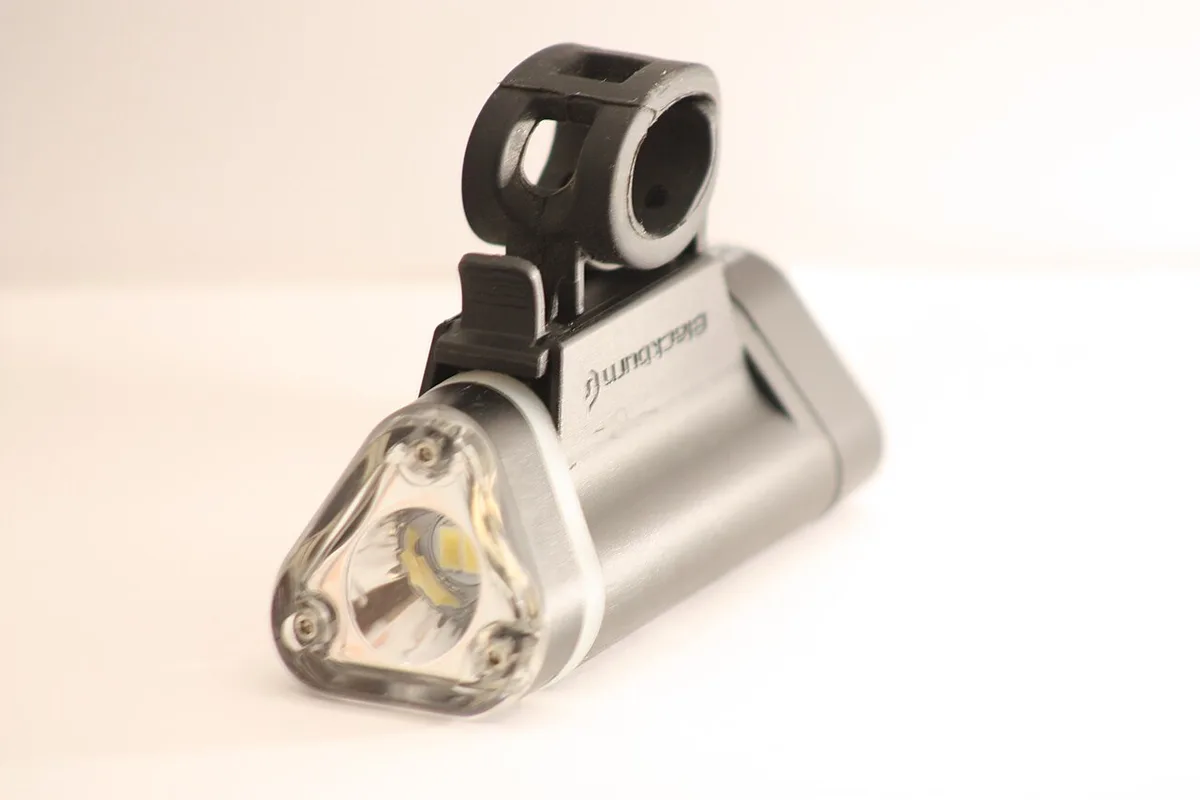
After following the instructions, a personal charging log can record when charging began, the indication observed and when the unit was disconnected. Note the actual conditions and any uncertainty rather than claiming a universal charge time from one observation. Do not bypass instructions to create a test. If the light behaves unexpectedly, stop relying on a guessed state of charge and consult the manufacturer. The photographs here show other rechargeable lights; they provide visual context, not a demonstration of the Knog connector, charging procedure or indicators.
Use the record to spot an unresolved assumption
Before an intended use, consult the equipment's actual status and instructions rather than only the calendar entry showing when you last plugged it in. Keep the charging record separate from the planned mode and any observed operating history. Check current local lighting requirements as another distinct part of the decision. This guide does not guarantee readiness, a route duration or battery health. Its practical purpose is to prevent a charging-time claim, a runtime claim and a personal observation from being mixed into one number that appears more certain than the evidence supports. Keep the instruction revision with the log when you save it.
Open official model documentation ? Open official model documentation ?